Blog
How to Calculate a Rectangular Prism
A reliable method: measure length, width, and height, choose the calculation type, apply the correct formula, and verify units before you report the answer.
By Rectangular Prism Calculator

Blog
A reliable method: measure length, width, and height, choose the calculation type, apply the correct formula, and verify units before you report the answer.
By Rectangular Prism Calculator
Measure l, w, h in one unit, select volume/TSA/LSA/diagonal, substitute, then label cubic or square units.
Formula
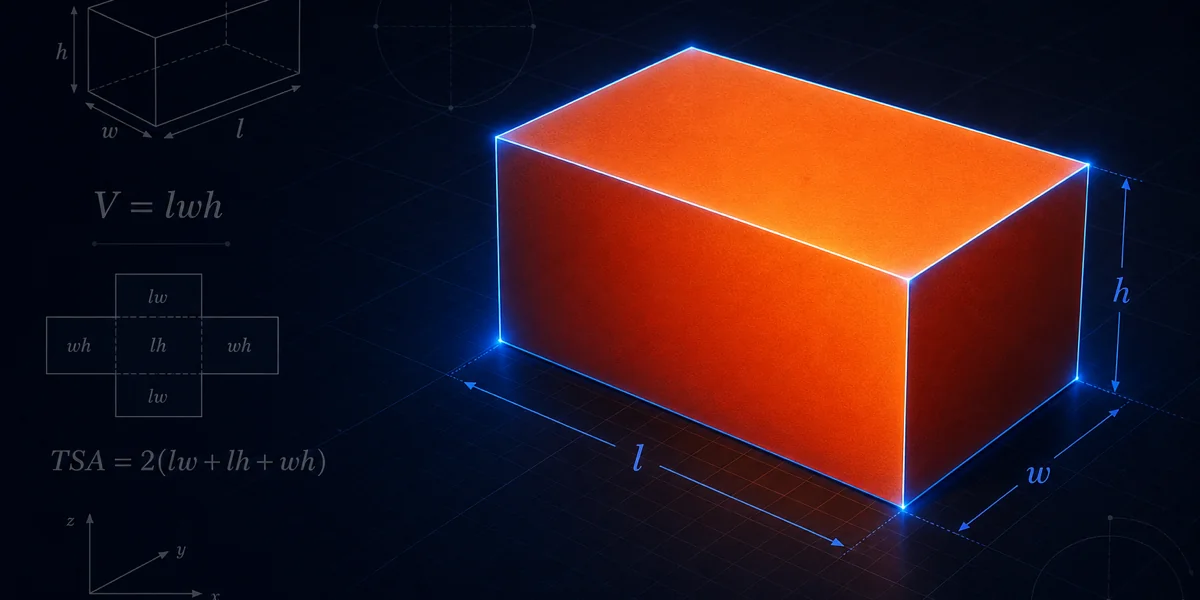
Rectangular Prism Calculator helps you calculate volume, surface area, and the space diagonal from length, width, and height.
A reliable method beats guessing which formula fits a story problem. This walkthrough stays close to homework, site measurement, and packaging wording you will see in the field.
You will measure three edges, choose the calculation type, apply the correct expression, and verify units before you report the answer.
Keep rectangular prism formulas open as a reference while you practice the steps below.
Calculation here means turning three edge lengths into volume, surface area, lateral area, or a diagonal using standard geometry rules, not guessing from the largest number in the prompt.
Accuracy depends more on consistent units than on memorizing extra symbols. Convert every edge to one system before you multiply or add squared terms.
Forward problems give you l, w, and h and ask for V, TSA, or d. Reverse problems give volume or area and ask for one missing edge; those need algebra on paper even when a forward calculator checks the final triple.
After you master the process, rectangular prism examples show the same method on cartons, rooms, and mixed unit drills.
Read the prompt carefully: words like fill, capacity, and interior usually point to volume. Words like wrap, paint, foil, and cover point to surface area.
If the problem mentions walls only or excludes top and bottom, switch to lateral surface area instead of total surface area.
Show intermediate products when your instructor awards partial credit: lw, lh, and wh before you add or double.
Diagonals require squaring each edge, adding, then taking one square root; do not add edge lengths directly.
Use this order for homework, site checks, packaging quotes, or classroom labs.
Problem: A crate is 1.2 m by 0.8 m by 0.5 m. How much interior space does it hold?
Interior capacity is 0.48 cubic meters if the crate is modeled as a perfect prism.
Repeat the five-step method until unit labeling and formula choice feel automatic.
Forward checks on the home calculator save time; reverse problems still need algebra on paper first.
Pair this guide with the formulas article when a new symbol or lateral area case appears.
Space diagonal of a rectangular prism with d = √(l² + w² + h²). Face vs interior diagonals, steps, and examples you can verify online.
Rectangular prism vs cube: equal vs unequal edges, formula shortcuts, volume and surface area comparisons, and misconceptions clarified.
Rectangular prism examples with full volume, surface area, and diagonal solutions for geometry, shipping cartons, rooms, and cube cases.