Blog
Rectangular Prism vs Cube
A cube is a rectangular prism with l = w = h. The general prism allows three different edges and uses the same core formulas.
By Rectangular Prism Calculator

Blog
A cube is a rectangular prism with l = w = h. The general prism allows three different edges and uses the same core formulas.
By Rectangular Prism Calculator
Cube: l = w = h. Prism: l, w, h may differ. Both use V = lwh.
Formula
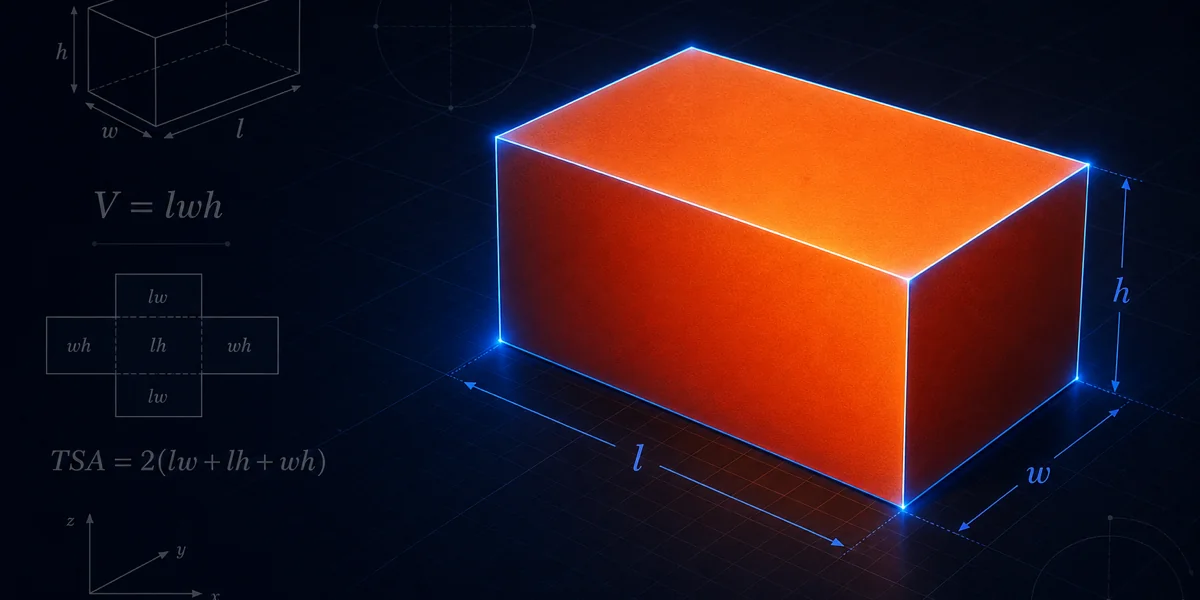
Rectangular Prism Calculator helps you calculate volume, surface area, and the space diagonal from length, width, and height.
A cube is a rectangular prism with l = w = h. The general prism allows three different edges but uses the same core formulas.
Tests often ask you to spot the special case quickly so you can simplify arithmetic without learning a separate shape family.
Most real cartons are prisms with unequal edges, not cubes. Recognizing that saves time on packaging problems.
Students sometimes treat cubes as unrelated to prisms. In standard naming, cubes sit inside the prism category with all faces still rectangles.
A cube has twelve equal edges. A general prism has three independent edge lengths that may differ.
Misconceptions include using perimeter formulas on surface area tasks or assuming every box must have equal edges because it looks “square” from one view.
If naming still feels unclear, revisit what is a rectangular prism for faces, edges, and vertices before comparing special cases.
Substitute s for l, w, and h in the prism formulas to recover cube shortcuts. That substitution is worth practicing once on paper.
Equal maximum edge length does not imply equal volume or surface area when the other two edges differ.
When only one edge is labeled s but the others differ, stay with prism formulas; do not force cube notation.
Full symbol tables live in rectangular prism formulas when you want lateral area and diagonal lines beside the cube case.
Use this order for homework, site checks, packaging quotes, or classroom labs.
Problem: Compare a 5 cm cube and a 5×4×3 cm prism.
The cube encloses more volume and needs more wrap than this prism despite sharing one edge length.
Start with prism formulas, then simplify when all three edges are equal.
Spotting unequal edges early prevents applying cube shortcuts incorrectly.
Verify numeric drills on the home calculator with the actual measurements from the problem.
Space diagonal of a rectangular prism with d = √(l² + w² + h²). Face vs interior diagonals, steps, and examples you can verify online.
Rectangular prism examples with full volume, surface area, and diagonal solutions for geometry, shipping cartons, rooms, and cube cases.
Find a missing length, width, or height from volume or surface area. Reverse prism formulas, algebra steps, and forward-check tips.