Blog
What Is a Rectangular Prism?
A rectangular prism is a box-shaped 3D solid with six rectangular faces. This guide defines the shape, names its parts, and links to formulas and the calculator.
By Rectangular Prism Calculator

Blog
A rectangular prism is a box-shaped 3D solid with six rectangular faces. This guide defines the shape, names its parts, and links to formulas and the calculator.
By Rectangular Prism Calculator
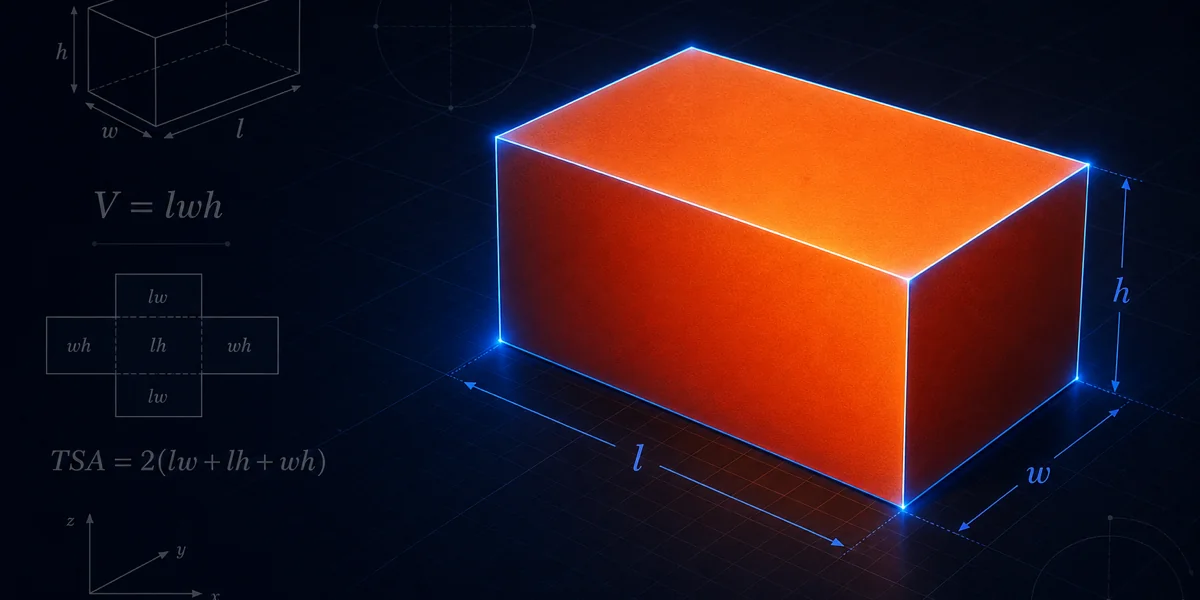
A rectangular prism is a right prism whose faces are rectangles, described by length l, width w, and height h.
Formula
Rectangular Prism Calculator helps you calculate volume, surface area, and the space diagonal from length, width, and height.
Before you multiply anything, it helps to name the solid correctly. A rectangular prism is the standard box model in geometry, logistics, and introductory engineering sketches.
This guide explains the shape in plain language, connects it to the symbols you will see on tests, and points you toward deeper articles when you are ready for numbers.
When you already know the three edges and only need results, open the home tool. When you need vocabulary for a report or lesson plan, stay on this page and follow the sections below.
Picture a cereal carton or a shipping case: six flat faces, each one a rectangle, with opposite faces matching in size. That mental image is a rectangular prism, also called a cuboid or rectangular box in many textbooks.
Length, width, and height are measured along perpendicular directions. They are not interchangeable labels; pick one edge as length on your diagram and keep that assignment through every later calculation.
The prism is a right prism in the usual school model: side faces are rectangles and the bases are rectangles aligned so adjacent edges meet at 90°. That right-angle picture is what makes the standard volume and surface area formulas work without extra trigonometry.
If all three edges are equal, the solid is a cube, a special prism case you will simplify in later homework even though the general box formulas still apply.
You do not need every formula on day one, but seeing them early connects the shape to homework you will meet later. Volume answers how much space is inside; total surface area answers how much material covers the outside; the space diagonal cuts corner to corner through the interior.
Each symbol stands for a single edge length in one unit system. Mixing centimeters on one edge and inches on another without converting first is one of the most common reasons two students get different “correct” answers.
For symbol rules, unit tables, and lateral surface area, continue to rectangular prism formulas once you can sketch and label l, w, and h confidently.
When you move from definitions to arithmetic, how to calculate a rectangular prism walks through measuring edges, picking the right target, and checking units before you submit work.
Use this order for homework, site checks, packaging quotes, or classroom labs.
Problem: A storage bin is 40 cm by 25 cm by 20 cm. Name the shape, list its faces, and note which formulas apply if numbers are required.
Shape identified; use V = lwh and TSA = 2(lw + lh + wh) when the problem moves from naming to calculating.
You now have a clear definition, a picture of faces and edges, and a preview of the formulas that describe the same box.
Move next to the formulas article for full symbol rules, then practice with the home calculator when you want fast verification.
Keeping one consistent unit system on every edge is the habit that makes later volume and area work trustworthy.
Space diagonal of a rectangular prism with d = √(l² + w² + h²). Face vs interior diagonals, steps, and examples you can verify online.
Rectangular prism vs cube: equal vs unequal edges, formula shortcuts, volume and surface area comparisons, and misconceptions clarified.
Rectangular prism examples with full volume, surface area, and diagonal solutions for geometry, shipping cartons, rooms, and cube cases.