Blog
Rectangular Prism Dimensions Calculator
Forward calculators give V, TSA, and d from l, w, h. Reverse problems start with a known volume or area and solve for one missing edge.
By Rectangular Prism Calculator

Blog
Forward calculators give V, TSA, and d from l, w, h. Reverse problems start with a known volume or area and solve for one missing edge.
By Rectangular Prism Calculator
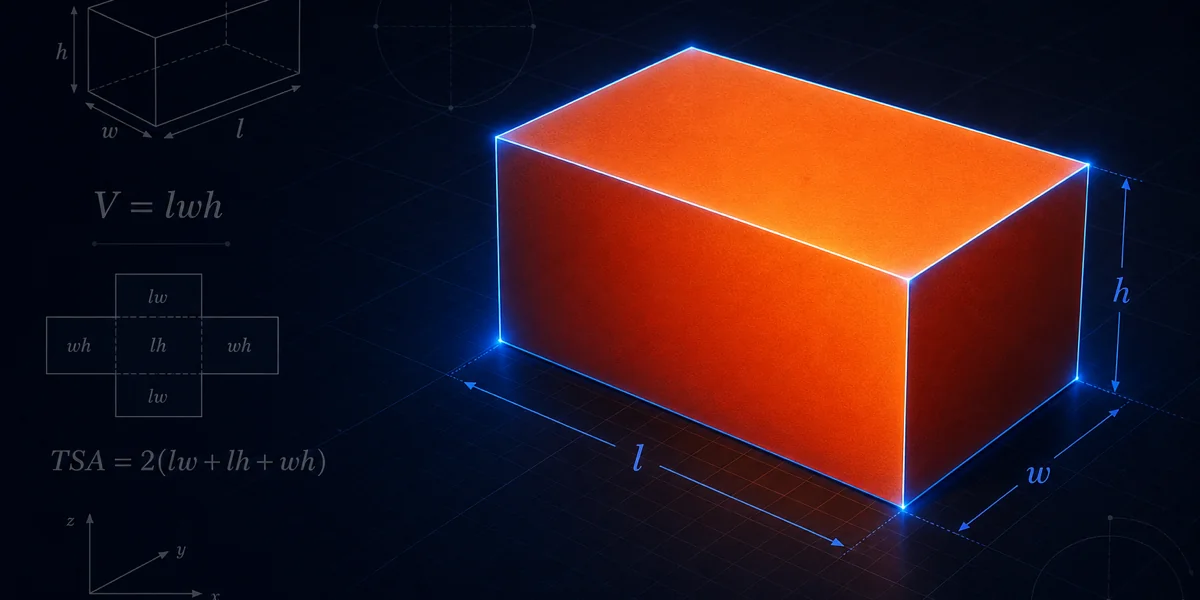
From V = lwh: missing edge = V ÷ (product of known edges).
Formula
Rectangular Prism Calculator helps you calculate volume, surface area, and the space diagonal from length, width, and height.
Forward mode gives results from three known edges. Reverse problems start with a known volume or surface area and solve for one missing edge using algebra.
This article explains the dimensions mindset, shows rearrangements of V = lwh, and tells you how to forward-check a recovered triple.
A forward-only browser tool still helps after you isolate the unknown on paper.
A dimensions calculator mindset means treating l, w, and h as unknowns in the same formulas used forward. You are not changing the geometry; only which symbol you solve for last.
Volume reverse is the most common classroom case: divide V by the product of the two known edges to get the third.
Surface area reverse expands 2(lw + lh + wh), substitutes known values, and isolates one edge. Distribution mistakes are common, so line up parentheses carefully.
Refresh forward steps in how to calculate a rectangular prism before you invert the same equations for a missing edge.
Keep units consistent before dividing. If V is in ft³, known edges in the divisor must be in feet.
When two edges appear on the base in a volume story, multiply them first, then divide V by that product.
For TSA reverse, write the expanded form with numbers in place of known edges before you collect the unknown.
Capacity context for reverse volume drills appears in volume of a rectangular prism when you want parallel vocabulary.
Use this order for homework, site checks, packaging quotes, or classroom labs.
Problem: Volume is 360 cm³. The base is 12 cm by 10 cm. Find the height.
Height is 3 cm if the prism model is exact.
Reverse steps reinforce the same formulas used forward; only the unknown moves.
Always forward-check the recovered triple on the home calculator.
Unit consistency before dividing is what makes reverse volume problems trustworthy.
Space diagonal of a rectangular prism with d = √(l² + w² + h²). Face vs interior diagonals, steps, and examples you can verify online.
Rectangular prism vs cube: equal vs unequal edges, formula shortcuts, volume and surface area comparisons, and misconceptions clarified.
Rectangular prism examples with full volume, surface area, and diagonal solutions for geometry, shipping cartons, rooms, and cube cases.