Blog
Surface Area of a Rectangular Prism
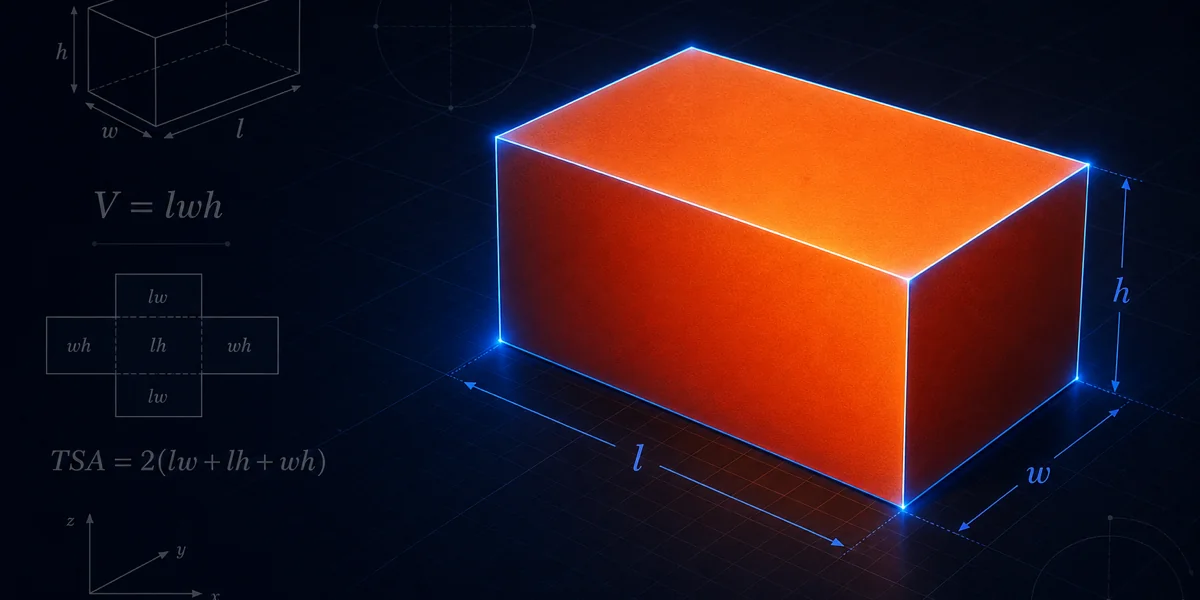
Total surface area covers all six faces. Lateral surface area covers the four sides only. Both start from the same l, w, and h.
By Rectangular Prism Calculator

Blog
Total surface area covers all six faces. Lateral surface area covers the four sides only. Both start from the same l, w, and h.
By Rectangular Prism Calculator
TSA = 2(lw + lh + wh). LSA = 2h(l + w).
Formula
Rectangular Prism Calculator helps you calculate volume, surface area, and the space diagonal from length, width, and height.
Total surface area covers all six faces. Lateral surface area covers the four side faces only. Both start from the same l, w, and h.
Paint, gift wrap, and insulation estimates often begin here, not with volume, so learning the face breakdown prevents costly unit errors. A percentage calculator app can help with related calculations.
Read the problem twice to see whether the top and bottom count before you choose TSA or LSA.
Surface area is a sum of flat rectangle areas, so answers use square units. Each face of the prism is a rectangle whose area is a product of two edges.
Top and bottom each have area lw. Front and back each have area lh. Left and right each have area wh. Total surface area counts all six.
Lateral surface area excludes the top and bottom when the story is about four walls only, such as a label band around a carton without lids.
Interior fill questions belong with volume of a rectangular prism; keep square and cubic answers separate even when one story mentions both ideas.
Compute lw, lh, and wh, add them, then multiply by 2 for total surface area. That pattern is faster than listing six separate products.
For lateral area, multiply height by the perimeter of the base rectangle in the orientation you chose: 2h(l + w).
Waste and overlap in real wrap jobs are not modeled by the formula; add a margin in practice after you find the geometric minimum.
Symbol details and when to pick LSA versus TSA are summarized in rectangular prism formulas for quick reference.
Use this order for homework, site checks, packaging quotes, or classroom labs.
Problem: Gift box 20 cm by 15 cm by 10 cm needs wrap on every face. What is the total surface area?
You need 1,300 square centimeters of wrap for full geometric coverage (add extra for overlap in real jobs).
Pick TSA or LSA before you substitute numbers, and write square units on the final line.
Face-by-face reasoning helps you catch when a problem excludes lids or bases.
Check results on the home calculator to confirm the breakdown for your labeled edges.
Space diagonal of a rectangular prism with d = √(l² + w² + h²). Face vs interior diagonals, steps, and examples you can verify online.
Rectangular prism vs cube: equal vs unequal edges, formula shortcuts, volume and surface area comparisons, and misconceptions clarified.
Rectangular prism examples with full volume, surface area, and diagonal solutions for geometry, shipping cartons, rooms, and cube cases.