Blog
Volume of a Rectangular Prism
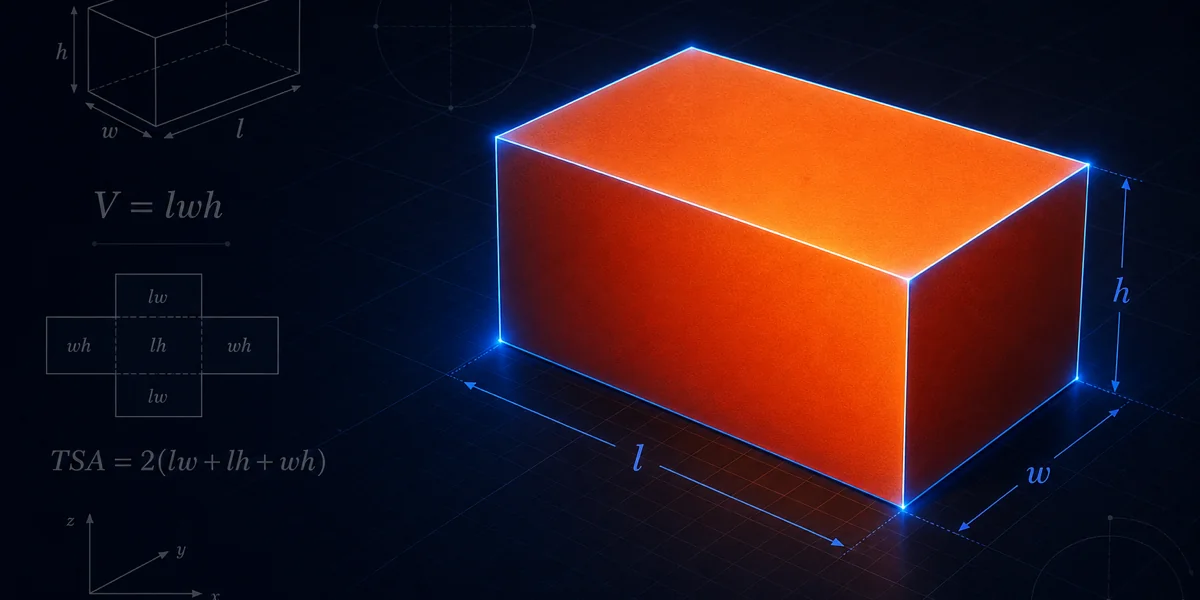
Volume measures how much three-dimensional space a box occupies, using cubic units and the formula V = l × w × h.
By Rectangular Prism Calculator

Blog
Volume measures how much three-dimensional space a box occupies, using cubic units and the formula V = l × w × h.
By Rectangular Prism Calculator
Volume V = lwh, reported in cubic units such as m³, ft³, or cm³.
Formula
Rectangular Prism Calculator helps you calculate volume, surface area, and the space diagonal from length, width, and height.
Volume measures how much three-dimensional space a box occupies. It answers fill, storage, and capacity questions using cubic units.
This guide defines volume for the prism model, walks through V = lwh, and highlights mistakes that appear on tests and in warehouse math.
Surface coverage is a different idea; when a problem mentions wrap or paint, switch targets before you multiply.
Volume is the amount of space inside the prism, reported in cubic units such as m³, ft³, or cm³. It is not the same as surface area, which measures the outer skin in square units.
Shipping planners use volume for capacity. Science teachers use volume for liquid or grain fill stories. Construction teams sometimes model pours as prisms when a form is box-shaped.
You may think of volume as stacking a rectangular base layer through height: multiply the base area lw by h, which is why a single cubic unit appears in the answer.
When a prompt also asks how much material covers the outside, open surface area of a rectangular prism and solve that part with square units instead of mixing formulas.
Multiply the three perpendicular edges. Order does not matter, but unit consistency does.
If the base is already computed as lw, multiply that area by height h for the same result.
Word problems may give liters or gallons after you find cm³ or ft³; convert with an explicit factor rather than guessing.
Worked numeric sets with mixed givens appear in rectangular prism examples when you want extra practice beyond a single crate story.
Use this order for homework, site checks, packaging quotes, or classroom labs.
Problem: Aquarium modeled as 50 cm by 30 cm by 40 cm. What is the volume?
Volume 60,000 cm³, about 60 L for the idealized prism model.
Volume answers how much fits inside the prism model. Label cubic units clearly in every final sentence.
Pair volume work with surface area articles when a problem covers both capacity and coverage.
Verify with the home calculator after you solve by hand.
Space diagonal of a rectangular prism with d = √(l² + w² + h²). Face vs interior diagonals, steps, and examples you can verify online.
Rectangular prism vs cube: equal vs unequal edges, formula shortcuts, volume and surface area comparisons, and misconceptions clarified.
Rectangular prism examples with full volume, surface area, and diagonal solutions for geometry, shipping cartons, rooms, and cube cases.